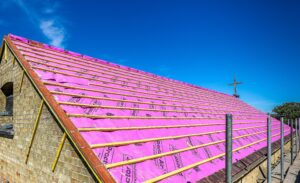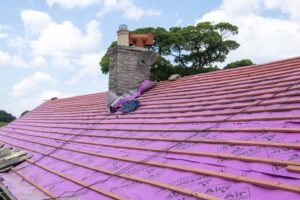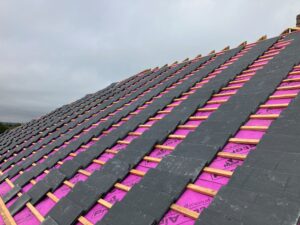

A former fishing bothy on the Carnoustie coast is being transformed into a beach house by retired chemical engineer David Gibson. The project uses two different membrane products from the A. Proctor Group: Facadeshield® UV and Proctor Air®.
The narrow site (3.5 m x 8 m) meant that David retained the original sleeper foundations, reducing the existing brick walls to one metre and constructing a timber frame above.
Initially planning open-jointed cladding, he selected Facadeshield UV for its UV resistance, vapour permeability and water resistance. Although fire safety regulations later required switching to closed cladding, the membrane remained valuable. Left exposed for three months, it effectively protected the OSB sheathing during construction delays.
For the roof, David chose Proctor Air, an air-permeable low-resistance (APLR) membrane, ideal beneath a traditional slate finish. Its ability to ventilate the roof space and remove any risk of condensation made it particularly suitable for the building’s exposed coastal location and monopitch roof design.
David praised the installation process as ‘intuitive,’ although he did enlist help with the roof membrane installation. With a background in engineering, he calculated U-values and condensation risk himself, supported by the A. Proctor Technical Team and Building Control.
As external works near completion, David plans to use Reflectatherm® Plus internally to improve thermal performance.