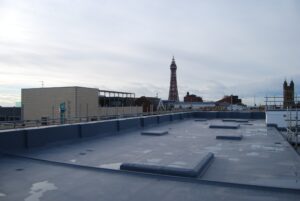

The NHS is trying to deliver modern healthcare from an estate containing ageing buildings, increasing maintenance demands and a growing need for investment. Flat roofing is an important part of that picture, but there is surprisingly little national data telling us exactly how many NHS flat roofs exist, how old they are or what it would cost to replace them. What we do know is that the condition of the estate is becoming an increasingly important operational issue, writes Justin Pitman, Sales Director at Proteus Waterproofing®.
The latest Estates Returns Information Collection (ERIC), published by NHS England, puts the estimated cost of eradicating backlog maintenance across the NHS estate in England at £15.9 billion for 2024/25. This is the investment required to restore buildings and other estate assets to a defined acceptable condition based on assessed risk.
The backlog has been growing for several years. In 2023/24 it stood at £13.8 billion, a 15.7 per cent increase in one year. NHS Property Services says the latest backlog is now greater than the annual cost of running the entire NHS estate, but how much of that problem sits above our heads?
Ageing infrastructure is the bigger picture
There is currently no published national NHS statistic identifying the total area of flat roofing across the estate, the proportion of NHS buildings with flat roofs, how many have reached the end of their serviceable life or what replacing them would cost. That makes it impossible to put a precise figure on the NHS’s flat-roof problem. It does not, however, mean the issue can be ignored.
NHS Property Services surveyed 77 NHS estate leaders in March 2026, with 63 per cent identifying ageing infrastructure as their biggest barrier to reducing backlog maintenance. Funding constraints were identified by 53 per cent and the maintenance backlog itself by 38 per cent.
For roofing, those findings provide important context and in healthcare environments, the consequences can be particularly serious because buildings often have to remain
operational while maintenance takes place. Wards, treatment rooms, laboratories and diagnostic facilities cannot always simply be closed while work is carried out overhead.
NHS Property Services has acknowledged that clinical demand leaves little opportunity to close spaces for essential works, meaning short-term fixes can sometimes take priority over longer-term improvements.
For ageing roofs, the question therefore becomes more important than simply whether a leak can be repaired. Estates teams need to determine whether continued reactive maintenance remains sensible or whether the condition of the roof warrants planned investment and eventual replacement.
Flat roofs are found across many types of healthcare building and can develop a range of maintenance problems as they age. A roof with years of useful life remaining should be treated differently from one where repeated repairs are simply masking fundamental deterioration. For NHS estates teams working within limited budgets, understanding that difference is essential.
Detailed surveys, such as those provided free to NHS stakeholders by Proteus Waterproofing®, can establish the current condition of a roof, identify areas of concern and help determine whether maintenance, refurbishment or replacement represents the most appropriate long-term approach.
Replacement can be an opportunity
When an NHS roof does require replacement, there is also an opportunity to consider the wider performance of the building. NHS Property Services identifies roof replacement as an opportunity to incorporate additional insulation and improve energy efficiency. This supports the wider NHS focus on reducing energy consumption and progressing towards its net-zero ambitions.
Roof replacement therefore does not have to mean simply putting a new waterproof covering over an old building. Depending on the building and its future requirements, a project can provide an opportunity to consider thermal performance, drainage, access, maintenance, renewable energy and whole-life costs together.
However, the most important lesson from the NHS data is that reactive maintenance is becoming increasingly difficult to sustain. For flat roofs, effective asset management means understanding what exists across an estate, its age, construction, condition, repair history and likely remaining service life. This allows estates teams to prioritise investment according to risk rather than waiting for problems to become emergencies.
While there is no national figure showing exactly how much of the NHS maintenance backlog sits with flat roofs, the wider picture is unmistakable. For NHS estates teams, the challenge is therefore not simply keeping the rain out, but identifying which roofs need investment, when they need it and how that investment can deliver a more resilient, efficient and future-ready healthcare estate.